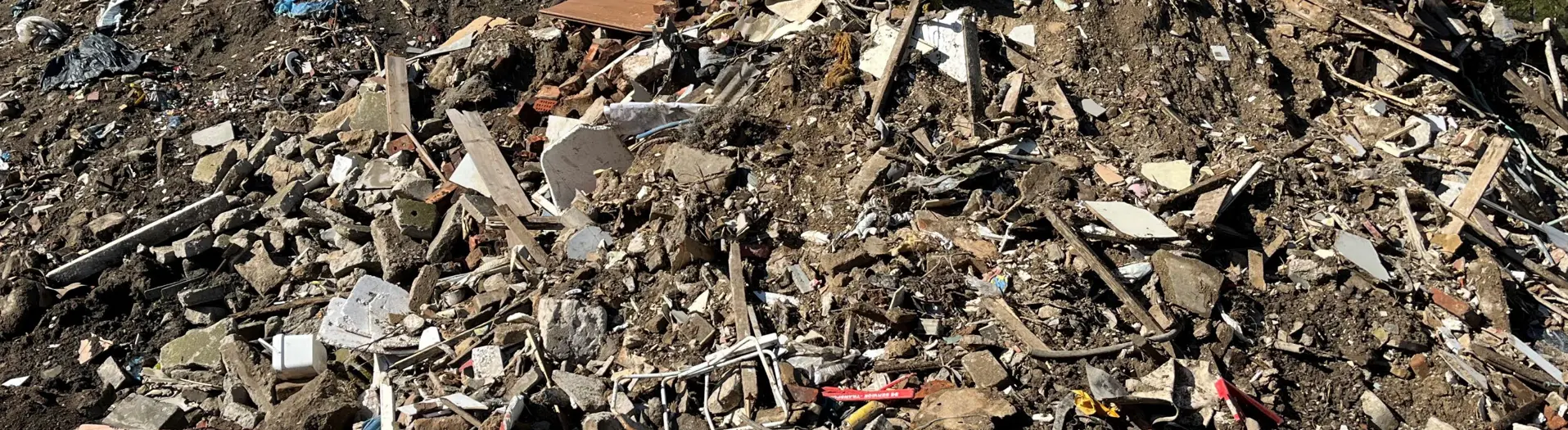
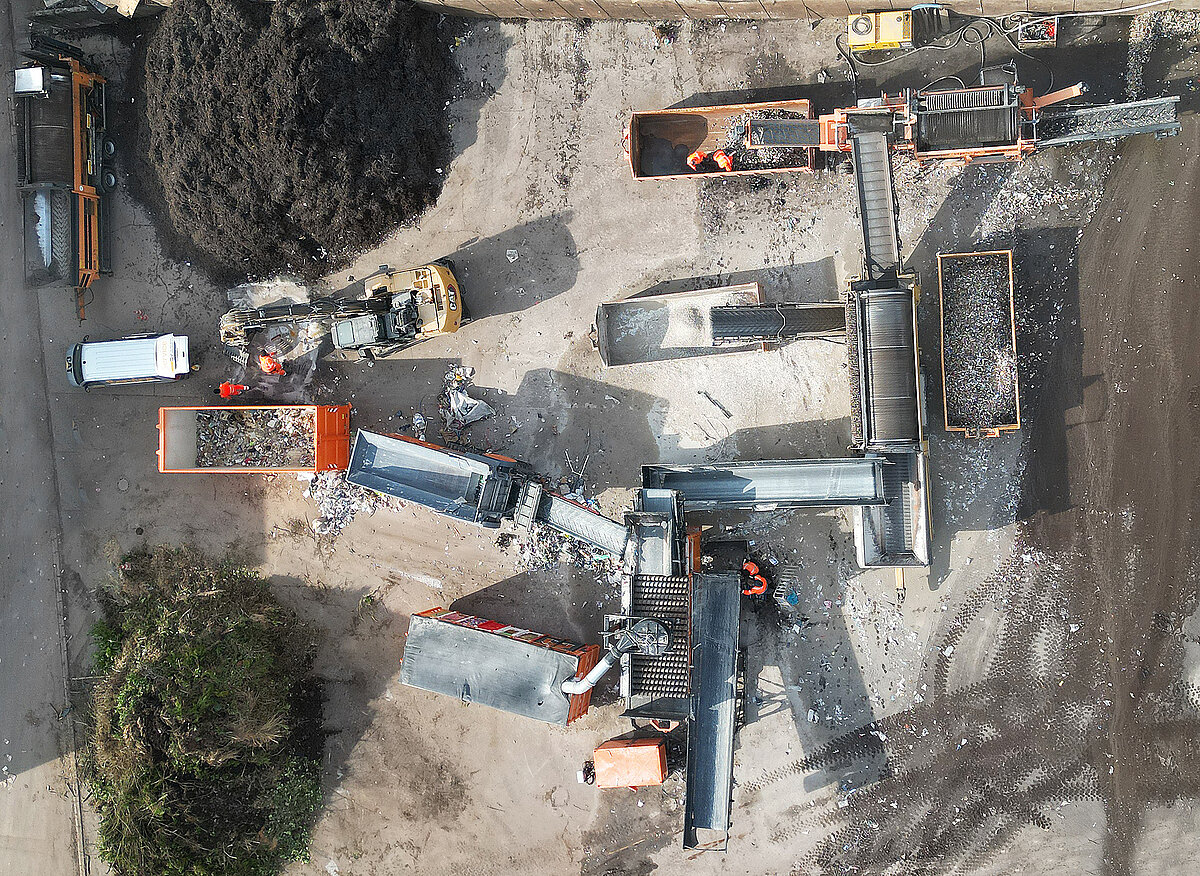
Construction waste or Contaminated demolition waste contains valuable raw materials such as concrete, wood and metals, the recovery of which represents a global challenge. With our Mobile Modular Processing Concept (MMPC), you can solve this problem efficiently: modular in design, flexible in use and economically attractive, the MMPC offers customised solutions for the processing of contaminated material flows - sustainable and future-proof.
THE FUTURE IS MOBILE-MODULAR.
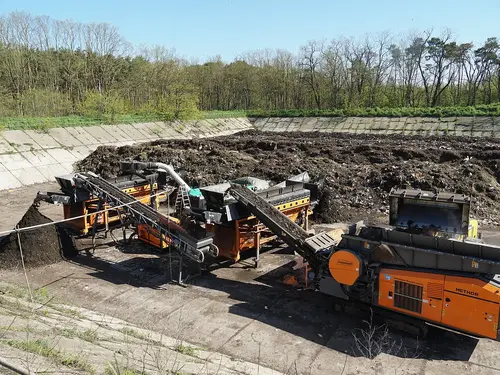
Our experts smartly combine robust Doppstadt machines and proven add-ons to create a mobile-modular system. You can use all machines flexibly in different fractions. You can react quickly to changing conditions by recombining the system components. This means you are ideally equipped for the economical and legally compliant processing of your mixed demolition waste - no matter what challenges await you in the future.
USE OUR IDEAS TO YOUR ADVANTAGE.
- By mobile-modular processing concepts, we mean the combination of mobile Doppstadt machines according to the modular principle. Intelligently combined, they can be used in many applications.
AN INVESTMENT THAT PAYS OFF.
- Future-proof solutions with Doppstadt's mobile modular processing concept MMPC
- Flexible utilisation of the machines in different fractions
- Quick response to changing conditions thanks to new combinations
- Low investment volume
- Reduction of disposal costs by approx. 30-40 %
USE OUR IDEAS TO YOUR ADVANTAGE.
By mobile-modular processing concepts, we mean the combination of mobile Doppstadt machines according to the modular principle. Intelligently combined, they can be used in many applications. As the operator, you have a wide range of options to customise the system precisely to your material and volume flows. If these change, you can react quickly. All machines can be flexibly moved and repositioned.
1
2
3
4
5
6
Contaminated demolition waste
Six steps that will take you further.
Six steps that will take you further.
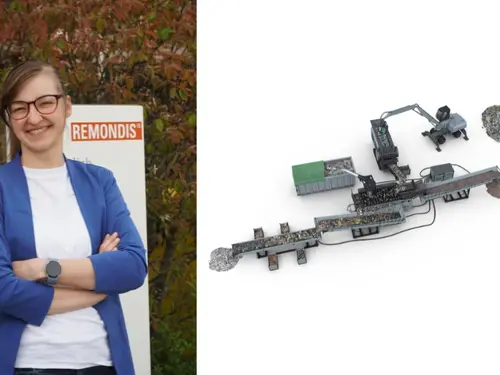
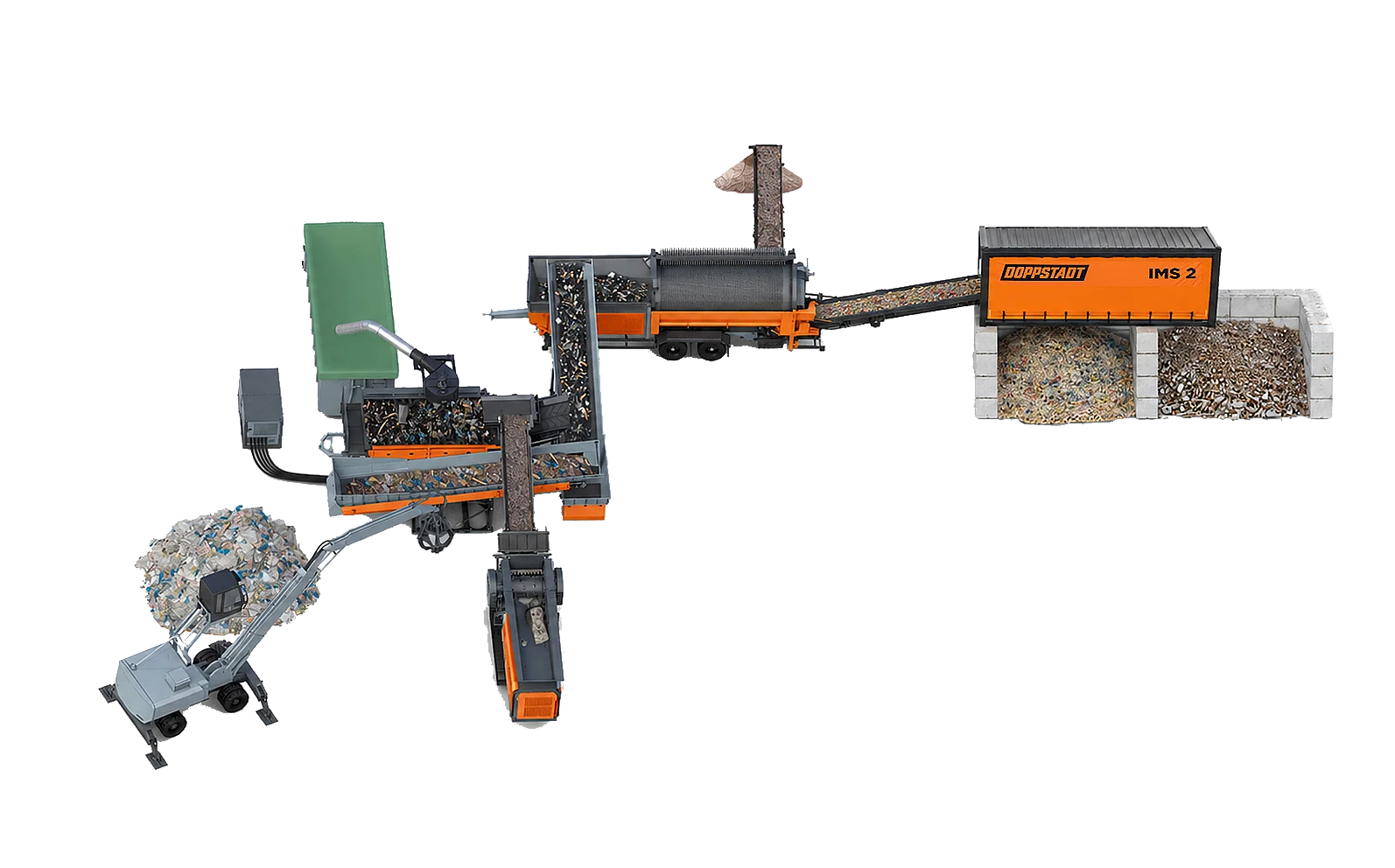
The presented processing concept is individually adapted to the respective material requirements of the customer. Depending on the input, process steps are added to meet customer needs and ensure the fastest possible ROI.
1 2 3 4 5 6
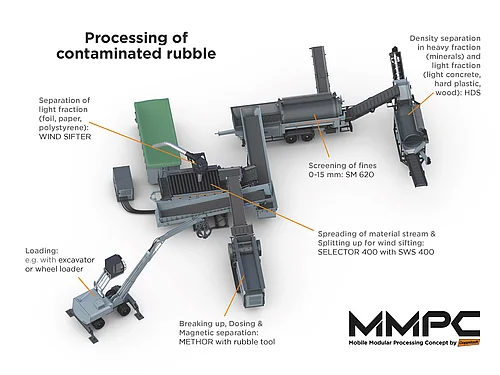
Pre-shredding and digestion of the material using Methor for dosed material feed for the subsequent processing steps.
Separation of the Fe component via overband magnet on the methor.
Separation of the material into coarse and fine grain using the SELECTOR 400. Uniform and spreading of the material flow for air separation.
Steplessly adjustable air separator for discharging 2D light fractions.
The fines (sand) are efficiently and reliably separated from the rest of the material flow using a Doppstadt screening machine.
MMPC FAQs – Mixed Construction Waste and Contaminated Construction Debris – You can find general questions about the mobile-modular processing concept under General FAQs.
Yes. The MMPC concept is suitable for processing mixed construction waste as well as mixed construction and demolition waste. It combines shredding, screening, air separation and sorting technology and can be adapted to different input materials, contaminant levels and desired output qualities.
The Doppstadt IMS 2 performs sensor-based sorting of defined material fractions. Depending on the material, particle size and sorting task, materials such as wood, plastics, metals or mineral components can be detected and separated. This enables recyclables to be recovered, contaminants to be reduced and mineral fractions to be specifically upgraded.
Yes. Contaminated construction rubble can be treated using coordinated screening, air separation and sorting technology. The aim is to remove foreign materials such as wood, films, plastics, metals or gypsum from the mineral fraction and improve the quality of the mineral output fraction.
The IMS 2 can automatically separate defined contaminants and valuable materials from the material stream. This enables recyclable components to be recovered, mineral fractions to be improved and downstream disposal or processing steps to be reduced.
A material test is recommended. Representative input material enables a realistic assessment of the plant configuration, sorting task, throughput, contaminant levels and achievable output quality. The results provide an important basis for technical project engineering.
A plant layout for mixed construction and demolition waste can consist of several process steps, for example pre-shredding, screening, air separation, metal separation, sensor-based sorting and material discharge. The specific arrangement depends on the input material, target quality, available space and desired throughput.
Typical applications fall within AVV Chapter 17 for construction and demolition waste, particularly non-hazardous mixed construction and demolition waste such as AVV 17 09 04 and mineral material streams such as AVV 17 01 07. However, the final classification and admissibility always depend on the specific material, possible contamination, the permit and the assessment by the competent authority.
Doppstadt offers a dust suppression system for mobile machines and MMPC plants. Foam is applied specifically at dust-intensive transfer, shredding or discharge points and binds dust as close as possible to the source. Whether and to what extent the requirements of ABA-VwV, TA Luft or official conditions are met must be assessed on a project- and location-specific basis.
The dust suppression system consists of the following components:
- Control cabinet (control and regulation unit)
- Foam mixer incl. 25 m spiral hose
- Stainless-steel foam nozzle
- Radio remote control
- Bracket for attaching the nozzle bar to the Doppstadt machine
Retrofitting is generally possible and is assessed based on the application. Sales and technical integration of the system currently apply to Doppstadt machines. Requirements include suitable mounting points, available utility connections, sufficient space and safe integration into the machine or plant concept.
Compressed-air and water supplies are not included in the scope of delivery and must be provided by the operator.
Operation requires a suitable unit for generating compressed air as well as a water connection. The specific technical specifications, connection values and requirements are defined on a project-specific basis in the quotation or technical design.
The expected delivery time is approximately six weeks after receipt of the written order. As part of an MMPC plant, the delivery time depends on the overall planning, the plant components used and project-specific availability.
A foam mixer combines concentrate, water and compressed air to form a stable foam. The foam settles on the material to be treated, wets dust particles and supports dust binding directly at the source.
The duration of the binding effect depends on the material, dust load, moisture, weather conditions, handling frequency and process management. Depending on the application, the residual binding effect can last from several hours to several days.
As a rule, significantly less water is required than with conventional water spraying because the foam creates a larger volume and a larger wetting surface.
The mixing ratio is set on a project- and material-specific basis; a ratio of approximately 1:100 can be used as a guideline, provided this is confirmed by the technical design.
- Lower investment costs compared with structural measures such as enclosure, encapsulation or extraction, depending on the specific plant concept
- Targeted dust binding at relevant points of origin; existing expert reports or evidence should be considered on a project-specific basis
- Reduced water consumption compared with conventional spraying, depending on material, dust load and operating method
- Potential residual dust-binding effect after treatment, depending on the application and ambient conditions
There is no blanket official approval, as the competent authority decides on a case-by-case basis which measures are recognised in the respective permit or regulatory context. The dust suppression system has already been used in several German federal states; however, recognition should be coordinated with the competent authority on a project- and location-specific basis.
Drinking-water quality is recommended. Self-treated water should be individually approved by the manufacturer.